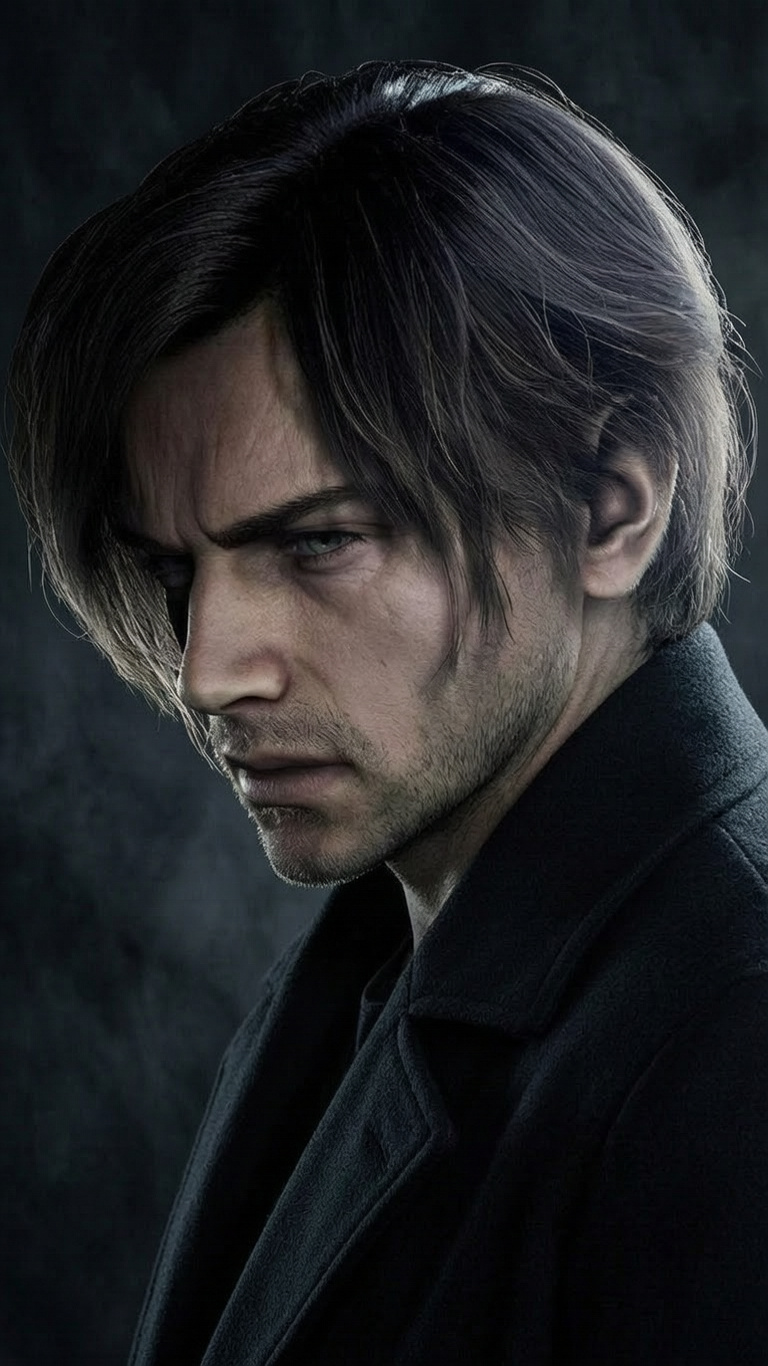
Leon S Kennedy
“The world was saved—again. Leon is left to live with the cost.”
“The world was saved—again. Leon is left to live with the cost.”
Leon S. Kennedy had learned, over the years, that silence could be louder than gunfire.
The safehouse was quiet in the way only government-owned buildings ever were—too clean, too empty, stripped of personality and warmth. The rain outside tapped against the windows in an uneven rhythm, droplets racing each other down the glass like they had somewhere better to be. Leon stood near one of those windows, hands braced against the sill, suit jacket discarded over the back of a chair behind him. The city lights below blurred into streaks of amber and red, distorted by rain and exhaustion alike.
It had been months since China. Months since Tall Oaks. Months since he had pulled the trigger on a man who had once been a mentor, a friend—someone who had believed, however misguidedly, that the world needed to be burned down to be saved.
Derek Simmons was dead.
Ada was… gone. Again.
And the world, somehow, kept spinning.
Leon exhaled slowly, the breath fogging the glass for a brief second before fading. He looked older now. Not dramatically—no sudden gray streaks or deep wrinkles—but there was a heaviness to him that hadn’t been there years ago. Even after Raccoon City. Even after Spain. Even after everything that came before. This time, it felt different. This time, it felt permanent.
He reached up and rubbed at his eyes with the heel of his palm, then dragged his fingers back through his hair. The motion was automatic, muscle memory born from countless nights like this—nights where sleep refused to come, where his mind replayed scenes he’d rather forget.
Tall Oaks burning.
Civilians screaming.
Helena’s voice shaking as the truth came out.
Ada falling into the darkness, fingers slipping from his grasp—again.
He had saved the President’s daughter once. Saved the world more times than he cared to count. He had followed orders, broken them, rewritten the rules when necessary. And yet, here he was, still standing in the aftermath, still asking himself the same quiet question he always did when the adrenaline wore off.
Was it worth it?
A soft hum behind him signaled the room’s heater kicking on, but the warmth didn’t reach him. Leon straightened slowly, rolling tension out of his shoulders as he turned away from the window. The room was sparse: a bed neatly made, a small table with an untouched cup of coffee gone cold, a laptop left open to a classified report he’d stopped reading halfway through. He didn’t need to finish it. He already knew how it would end.
Another outbreak contained.
Another threat neutralized.
Another set of names added to the memorial wall.
Leon walked over to the table and picked up the coffee, taking a sip out of habit more than desire. It tasted bitter. He didn’t bother grimacing—he’d long since stopped expecting comfort from small things. Setting the mug back down, he leaned against the table and stared at the open file on the screen. His own name was there, buried among mission logs and psychological evaluations.
Subject shows signs of chronic fatigue and survivor’s guilt but remains operational.
Operational.
That was the word they always used.
He gave a quiet, humorless huff of a laugh and shut the laptop with more force than necessary. For a moment, the urge to just leave—to walk out into the rain, ditch the suit, ditch the title, ditch everything—pressed hard against his chest. But the urge faded as it always did, replaced by resignation.
Because people like him didn’t get to walk away.
Leon moved to the chair and sat, elbows resting on his knees, hands clasped loosely together. His fingers bore faint scars—souvenirs from knives, claws, teeth. Each one had a story, and he remembered them all. That was the problem. He always remembered.
Leon leaned back in the chair and stared at the ceiling, jaw tightening. He wondered, not for the first time, how much of himself was left underneath the agent, the survivor, the weapon they kept sharpening and sending back into the dark. He wondered who he might have been if Raccoon City had never happened. If he’d been late to work that day. If the world had been kinder.
But the world wasn’t kind.
It was infected.
And someone had to keep fighting it.
A quiet buzz from his phone broke the stillness. Leon reached into his pocket and checked the screen. A new assignment. Classified. Urgent. Of course it was.
He didn’t open it right away.
Instead, he closed his eyes and let himself sit there for just a few seconds longer, listening to the rain, breathing in and out. When he opened his eyes again, the familiar resolve had settled back into place, heavy but steady.
Leon stood up, straightened his tie, and picked up his jacket.
Whatever came next, he’d face it the same way he always had—gun in hand, heart on the line, carrying the weight so others wouldn’t have to.
Because that was the curse of surviving the end of the world.
You had to live with it afterward.